
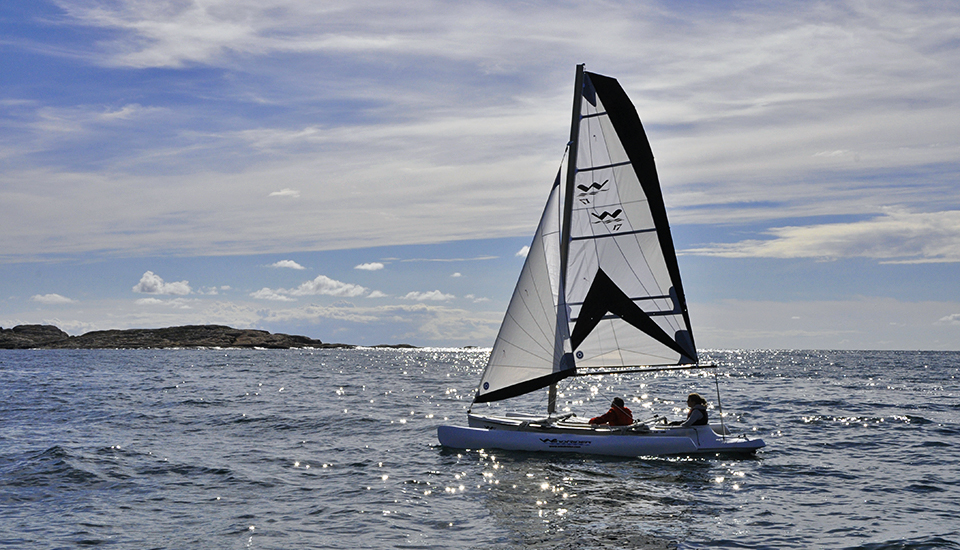
En internationell WindRider RAVE kappseglingsklass finns redan och välkomnar nya deltagare varje år.
Nedan kan du läsa mer om de kappseglingsregler som tillämpas i USA.
International WindRider RAVE Class
Association
General Rules
1. ONE-DESIGN CLASS RACING: The design and development of WindRider RAVE hydrofoil trimarans is directed towards strict one-design classes where the true test is between sailors and sailing skill, and not boats. Any alterations to the hull form, Foil Form, construction, equipment, spars, sails or running rigging, as supplied by the builder WindRider . or others, licensed by WindRider , except as is specifically authorized by these rules, are a breach of these rules, both in spirit and in substance, and are prohibited.
2. INTENT AND OBJECTIVE: WindRider RAVEs are designed to be easy to sail with the least amount of trouble to owners. Only changes that have no direct bearing upon boat speed are allowed unless they are specifically authorized by these rules. The intent and objective of the International WindRider RAVE Class Association (I.W.R.C.A.) rules are: a) To keep each boat as equal, simple and cost free as possible by rigidly maintaining, without deviation, the one-design features of the WindRider RAVE for class racing. b) To encourage the use of racing tactics and sailing skills only to increase boat speed.
2.1 DEFINITIONS: a) The International WindRider RAVE Class Association shall hereafter be referred to as the IWRCA b) Confluence Holding Corp. d/b/a Wilderness Systems, or WindRider shall hereafter be referred to as WindRider. c) The INTERNATIONAL SAILING FEDERATION (Old International Yacht Racing Union) shall be referred to as the ISAF. The UNITED STATES SAILING ASSOCIATION shall be referred to as USSA.
2.2 CLASS ORGANIZATION a) The IWRCA shall be lead by a rules committee composed of a: Chairman, Vice Chairman, Treasurer, and Secretary b) Approval of the IWRCA rules and any future changes to the IWRCA rules must be approved by a majority vote by this committee. c) Beginning January 2001, IWRCA members will select committee members by voting in January each year. Until January 2001, the committee shall be filled by the following people as agreed at the class formation meeting November 14, 1998 (see meeting notes appendix 1): Chairman: Eric Arens, Vice Chairman: Mike McGarry, Treasurer: Ira Helle, Secretary: Don Walton
3. RIGHT OF PROTEST: An owner/pilot or the race committee has the right to protest. The IWRCA has the right to declare ineligible any WindRider RAVE that does not conform to the spirit, objective and intent, as well as the letter of these rules and the official drawings and specifications held by the I.W.R.C.A.. 4. LOOPHOLES: IF YOU THINK YOU HAVE FOUND A LOOPHOLE, READ THE PRECEDING STATEMENTS AGAIN. THESE ARE THE BASIS OF THE RULES AND COVER ALL AREAS NOT COVERED IN THE RULES. GENERALLY, IF YOU CANNOT FIND IT LISTED IN THE RULES, IT IS NOT CLASS LEGAL. IF YOU ARE IN DOUBT, CHECK WITH THE IWRCA FIRST. APPROVAL MUST BE IN WRITING. 5. MANUFACTURER OF WindRider RAVE: Only boats manufactured by WindRider are legal for class racing. The manufacturing origin and trademarks of all boats must be readily identifiable through, hull numbers, sails and cast parts. Copies of original invoices or warranty cards may be requested. Proof of origin will be submitted to the IWRCA or its authorized representatives for verification upon demand of the race committee and/or protest committee. Pilots or owners of boats who have had the manufacturing origin of their boat officially questioned must be warned in advance of the manufacturing origin request and given a reasonable time (minimum two weeks) to produce acceptable proof of origin. WindRider reserves the right to make changes to these rules at its discretion in order to accommodate design/manufacturing necessities, to promote safety and/or to maintain the integrity of the one design class.
6. MANUFACTURERS OF EQUIPMENT: To be established
7. DESIGN FEATURES AND CHANGES: Nothing may be changed or removed from any WindRider RAVE that will, in any way, adversely alter the structural integrity, design function, or built-in safety features of the boat. All changes that fall under the category of safety and strength shall have prior written approval. The only approved changes are as follows: a) Larger diameter wires b) Reinforced flanges not affecting water flow.
8. SAFETY EQUIPMENT:
8.1 LIFE PRESERVERS, WHISTLES AND EYE PROTECTION: Each WindRider RAVE must be equipped with a U.S.C.G. approved PFD (Personal Flotation Device) life preserver for each person aboard, at least one U.S.C.G. approved throwable device, at least one "efficient" sound producing device (whistle, horn or bell) and all other safety equipment which might be mandated by the U.S.C.G., and local marine authorities having jurisdiction. PFDs or other suitable life jackets must be worn by all pilots and crews when code flat "Y" (or a PFD when code flag "Y" is not available) is displayed by the Race Committee. The IWRCA recommends that life jackets or PFDs as well as eye protection be worn at all times.
8.2 PADDLE AND ANCHOR: An appropriate paddle and anchor with leader and/or line is highly recommended but not required unless, as a result of special circumstances, is mandated by the race committee.
8.3 ADDITIONAL EQUIPMENT: Any additional equipment Including flashlights, flares, running lights anchor lights, etc. which may be required by a recognized authority having jurisdiction should be carried aboard.
9. HULLS AND DECKS: Hulls and decks may be smoothed, flashed, waxed, sanded or buffed in the normal process of maintenance Decks and beam shall have a non-skid surface at least equal to the original design area. Bailers, pumps and other devices to remove water from the hull(s) are allowed. 9.1 FRICTION REDUCING AGENTS: No friction reducing agents other than waxes, commercially available surface protectants, lubricants or soaps may be employed on the hulls, foils (including vertical sections) or sensor wands.
10. FOILS, RUDDER AND RUDDER ASSEMBLY:
10.1 General: WindRider RAVE supplied main foil T sections including vertical sections (dagger boards or rudder blade) and lifter sections shall not be modified except for minimum filing, filling, sanding, and smoothing to improve fit and function and to fair surfaces and openings and/or remove manufacturing blemishes if any. Trailing edges of foils/flaps may be filed, sanded or otherwise "dressed" to minimize hum and/or drag. Tips and flaps may be modified so long as no part of any tip or flap extends further than 1 1/4" from the end of the aluminum extrusion. Foils may be painted or otherwise coated to protect the surfaces. Foil extrusions may be foam filled to promote buoyancy. Repairs to lightly damaged foils and rudder may be made as long as the size, profile and cross sectional shape is not measurably altered. Pilots or owners of boats who have had the size, profile and cross sectional shape of their foil and/or rudder assemblies officially questioned must be given an opportunity to either demonstrate that their foils and/or rudder do(es) comply or to make such adjustments as are deemed necessary to achieve compliance. Allowed modifications are as follows:
10.2 Wands and Wand Couplings: The sensor wands may be lengthened, shortened or re-shaped and may be fabricated out of any material at the discretion of the owner/pilot. AFTER APRIL 1, 2000, Mechanisms designed to couple or de-couple the sensor wands and/or allow the flaps to be coupled, de-coupled or locked in position from the cockpit or other locations aboard the WindRider RAVE.
10.3 Raising and Lowering: Mechanisms designed to assist in raising or lowering the foil assemblies for shallow water operation from the cockpit or other locations aboard the WindRider RAVE.
10.4 Flap Override: Mechanisms designed to manually override the automatic flap control system to improve speed, ride or safety from the cockpit or other locations aboard the WindRider RAVE
10.5 SHIMS: Shims, spacers and bushings may be replaced and/or added to main foil assemblies, main beam attachment points at amas and center hull and transom/rudder assemblies to improve fit and function.
10.6 STEERING SYSTEM: The steering system of foot peddles, wires and lead blocks may not be functionally altered except that system components may be strengthened, dressed and lubricated and non-skid may be added to peddles. The aft cockpit is the only steering station aboard the WindRider RAVE and mechanisms designed to allow the pilot to steer from the forward cockpit or from outside the cockpit are NOT allowed.
11. Intentionally left blank
12. SAILS:
12.1 Only mainsails, jibs and screachers manufactured to IWRCA approved patterns. A WindRider factory supplied sail will be used as an official template for each sail, sails from other sources must fit within the boundaries of the factory provided sail in order to be allowed for class racing. Sails supplied by WindRider and/or other sail makers which may be designated from time to time as licensed WindRider RAVE sail makers may be used for racing. a) A sail may be repaired and/or re-cut slightly, provided the overall original size is not increased, other than normal stretch with aging and sail tuning. b) Windows and telltales may be added as desired.
12.2 BATTENS: Battens may be made of wood, fiberglass, Kevlar and/or carbon fiber and may be of composite foam sandwich construction.
12.3 ADVERTISING: Unlimited advertising on sails shall be allowed provided that such advertising generally meets accepted moral and ethical standards. WindRider RAVE events officially sponsored by WindRider shall be considered Category C events as described in Appendix A3 of the IYRU rules.
12.4 CHANGING SAILS: A pilot shall not change sails during a race or regatta unless his sail(s) has been damaged and is (are) no longer usable. Permission to make a sail change must be received, in writing, from the race committee PRIOR to the change being made.
12.5 SAIL NUMBERS: The mainsails shall have sail numbers affixed to the area in the upper third of the sail that either a) corresponds to the WindRider assigned WindRider RAVE number as found etched on the flanges of the beam, b) is a unique alpha numeric sequence assigned by a recognized national authority or c) is assigned by the I.W.R.C.A.. Sail numbers shall be no less than 12" (30.5 cm) in height.
12.6 WindRider RAVE INSIGNIA: The mainsails shall bear the WindRider name and WindRider RAVE registered trademark logo, which is the class emblem. The class emblem need only be shown on one side of the mainsail (over rides ISAF/USSA Racing Rules Appendix H, H1.3(a) requiring they be placed at different heights on two sides of the sail)
12.7 LUFF ROPE: Friction-reducing materials/devices may be applied to, or attached to, the luff rope or luff groove to help with raising the sail.
12.8 REEFING: Reefing is permitted and may be accomplished in any manner.
12.9 OTHER: The jib may be hoisted in any manner and may stand free of the headstay or be attached with hanks, tabs, zippers, hollow luff tapes or any other device at the discretion of the owner/pilot. The screacher may be hoisted in any manner and may be roller furling at the discretion of the owner/pilot.
13. SPARS
13.1 MAST AND MAIN BEAM: The length and section of the Mast, beam, and bowsprit extrusions shall not be altered in any way except:
13.2 ATTACHMENTS: Mast rotation limiters, over rotation controls, Cleats, bales, hooks, fairleads, blocks and other attachments may be added to spars so long as the fundamental operation and/or the structural integrity of the spars supplied by WindRider are not significantly altered.
14 STANDING RIGGING: Wires shall remain as supplied by WindRider. shall be of 1 X 19, all stainless steel construction and shall not be reduced in diameter. Wires may be shortened or lengthened at the discretion of the owner/pilot. Shrouds and forestays may be connected in any suitable manner at the discretion of the owner/pilot. Covers may be utilized to cover/protect the shroud adjusters.
15. RUNNING RIGGING:
15.1 LINES: All lines and bungees supplied with a WindRider RAVE may be altered with respect to length, diameter, color and materials at the discretion of the owner/pilot.
15.2 HALYARDS, SHEETS AND TWindRider RAVELERS: Halyards and halyard systems may be modified so long as the vertical hoist of the screacher is not altered. The main sheet system and jib sheet/tWindRider RAVEler control line may be altered and blocks, fair leads and cleats may changed and/or added so as to allow more convenient control of the incidence of the WindRider RAVE's sails. The addition of a tWindRider RAVEler with a tWindRider RAVEler car for the purpose of controlling the mainsheet is however specifically prohibited
15.3 TRAMPOLINES: Wing nets are allowed while racing. Storage pockets and flaps to minimize water spray may be added. Hand/foot holds may be fitted at the discretion of the owner/pilot. Battens, hardware and sleeves may be fitted to assist in routing of lines and retaining equipment.
15.4 HARDWARE AND SYSTEMS: Wind vanes, Cleats, pad eyes, eye straps, blocks and other miscellaneous hardware associated with running rigging may be added or altered. Downhauls, barber haulers, preventers, tweekers and other control systems may be installed at the discretion of the owner/pilot. Personal convenience accessories may be added (i.e.; tool kits, extra non-skid, stow bags. beverage coolers, etc.).
16. TIMERS, NAVIGATION AND ELECTRONIC DEVICES: Devices including stop watches, compasses, GPSs, VHF radios and other incidental electronic devices are allowed.
17. Intentionally left blank
18. CREW AND CREW WEIGHT
18.1 CREW: The word "crew" includes all personnel aboard the boat including the pilot.
18.2 CREW WEIGHT: A minimum total crew weight of 175 pounds for one-design racing shall be maintained at all times. Weight shall be determined by measuring the total weight of all crew members and the compensating weights carried aboard using the race committee's scale or other accurate scale with each crew member dressed only in dry shorts and shirt or the clothing worn while sailing whichever is estimated to weigh the least. Compensating weights which may include sand bags, barbells and/or other dedicated weights but, not tools, radios drinking water, and other useful supplies, shall be secured on, below or behind the rear (pilot's) seat of the WindRider RAVE. (This modifies IYRU rule 23.1). It is the pilot's responsibility to maintain at least the minimum weight for his/her weight category at all times. If required, the crew may have to add weight during the regatta to maintain minimum weight.
18.3 CREW SUBSTITUTIONS: The same crew shall be used throughout the race or regatta. Crew shall not be added or removed without prior written permission from the race committee. If a crew change is required due to injury or other special circumstances, the crew weight shall not be less than the original weight unless approved by the race committee. Weights may be secured on, below or behind the rear (pilot's) seat of the WindRider RAVE to maintain the original crew weight JURISDICTION OF RULES All regattas held within regions under the jurisdiction of the IWRCA shall be governed by these IWRCA General Rules, the "Special WindRider RAVE Racing Rules and/or the IYRU rules as per the prescriptions of the National Sailing Authority having jurisdiction; the current IWRCA Standard Sailing Instructions or IWRCA Class Event Instructions for major events; unless modified by race, regatta or event Notice of Race or Sailing Instructions. RULE INTERPRETATIONS AND RULE AMENDMENTS Valid questions regarding these General Rules may be ruled on an interim basis by the acting IWRCA representative body i.e. the race committee. The rulings, as needed, will be accepted, rejected or modified by the IWRCA Rules Committee by a _ majority before achieving permanent status in the General Class Rules. RULE AMENDMENTS Interim rulings, suggestions, recommendations or requests for rule amendments shall be submitted in writing to the IWRCA Rules Committee. Upon review the IWRCA Rules Committee shall accept, reject or modify the interim rulings, suggestions, recommendations or requests. The IWRCA Rules Committee may also initiate amendments to the IWRCA General Rules from time to time as it deems appropriate. WindRider reserves the right to make changes to these rules at its discretion in order to accommodate design/manufacturing necessities, to promote safety and/or to maintain the integrity of the one design class. Any new rule amendments and/or rule interpretations will be announced in one or more of the following ways: a) A mailing to all WindRider RAVE owners. b) An article or announcement in the quarterly newsletter, Up and About, c) An official reprint of the Rule book. An official copy of the IWRCA rules will remain posted on the WindRider website (www.windride.com). SAILING ABILITY: It is the responsibility of each Pilot, and crew if applicable, to sail safely within in his or her capabilities. If wind wave or water conditions make you doubtful of your ability to handle them safely, it is highly recommended that you retire from that race. This is NOT a disgrace. It is good sailing practice. ELIGIBILITY: Eligibility to race in a WindRider RAVE requires only that you be an owner/operator of an eligible WindRider RAVE craft as described in 5 above. Membership in the I.W.R.C.A., USSA and/or other yachting and yacht racing organizations is recommended but not required. In the interest of safety, in order to be eligible to race in a WindRider RAVE sponsored event a pilot must be: a) 16 years of age or older or b) Be accompanied by a qualified crew, 16 years of age or older with control of the WindRider RAVE via options as described in 10.4 c) and 15.2 of the IWRCA General Rules. or c) Able to demonstrate WindRider RAVE piloting ability and posses written approval by the IWRCA
SPECIAL INTERNATIONAL WindRider RAVE CLASS RACING RULES
l. Collisions: WindRider RAVEs shall make every attempt to avoid collisions, regardless of which tack they may be sailing. Any WindRider RAVE which (in the opinion of the race officials) fails to make a reasonable attempt to avoid a collision resulting in serious damage or bodily injury, will be penalized or disqualified.
2. Altering Course: A WindRider RAVE with right of way over a another WindRider RAVE which is required to keep clear may not alter course in any manner that will prevent the burdened WindRider RAVE from keeping clear or in any way obstruct her from her attempt to keep clear.
3. Starting Properly: A WindRider RAVE must not start prematurely. Any WindRider RAVE, which crosses the starting line prior to her starting signal, must immediately return to restart properly. The Race committee will attempt to notify the premature starter by flag (Code flag X) and/or sound signals(Three or more short blasts). Failure to restart properly will result in the WindRider RAVE being penalized or disqualified for that race.
4. Opposite Tack: A port tack WindRider RAVE shall keep clear of a starboard tack WindRider RAVE except as may be allowed in Rule 8.
5. Same Tack - Same Leg: When overlapped WindRider RAVEs converge, where they all, while sailing a proper course to the next mark, are required to sail to windward to best advantage (beating, close hauled) a windward WindRider RAVE shall keep clear of a leeward WindRider RAVE. When overlapped WindRider RAVEs converge, where they all, while sailing a proper course to the next mark, are on a free leg, a leeward WindRider RAVE shall keep clear of a windward WindRider RAVE. When WindRider RAVEs that are not overlapped converge, an overtaking WindRider RAVE shall keep clear of a WindRider RAVE clear ahead.
6. Same Tack - Different Legs: When overlapped WindRider RAVEs converge, where one or more, while sailing a proper course to the next mark, is required to sail to windward to best advantage (beating, close hauled) and where one or more other WindRider RAVEs are on a free leg of the course, and they are on the same tack, the WindRider RAVE(s) sailing on the free leg shall keep clear of the WindRider RAVE(s) that are working to windward to best advantage. When WindRider RAVEs that are not overlapped converge, an overtaking WindRider RAVE shall keep clear of a WindRider RAVE clear ahead.
7. Sailing the Course: A WindRider RAVE shall sail the course so that it rounds or passes each mark on the required side and in the correct sequence. To round properly a WindRider RAVE must pass each mark with all of her hulls/foils on the required side. Any WindRider RAVE which touches a mark or fouls the ground tackle of a mark causing it to shift substantially or break free and drift, may take a 360 turn penalty as described in the UNITED STATES SAILING ASSOCIATION 1997 -2000 Racing Rules of Sailing, rule 31 or, be disqualified for that race.
8. Mark Rounding: When two or more WindRider RAVEs are rounding a mark, the WindRider RAVE(s) overlapped on the outside shall provide room and opportunity for the inside WindRider RAVE(s) to round the mark and assume a proper course to the next mark and faster moving WindRider RAVEs, approaching from clear astern or abeam, shall keep clear of WindRider RAVEs which are rounding or are about to round a mark.
9. Room to Finish: WindRider RAVE shall be allowed room to cross the finish line.
10. Good Time: All WindRider RAVE pilots, crews and support personal SHALL HAVE A GOOD TIME.
Note: Special International WindRider RAVE Class Racing Rules and International WindRider RAVE Class Association General Rules are in effect where practical. U.S.S.A. International Yacht Racing Rules in effect in situations not covered by the above.